Ongoing Projects
Casting a Wider Net
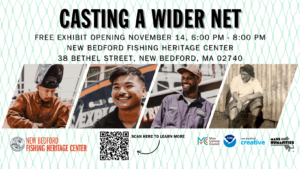
Casting a Wider Net is a community oral history project developed to collect and share the stories of Cape Verdean, Vietnamese, Puerto Rican, Mexican, and Central American members of the commercial fishing industry. The project provided ethnographic training for 9 individuals from those communities who led the documentation effort, conducting 14 interviews in English, Spanish, Kriolu, and Vietnamese. The resulting photographs, recordings, and transcripts will become part of the FHC archive and the NOAA Voices web-based archive and are the basis of FHC’s upcoming gallery exhibit. The Center hopes that this pilot project will serve as a launchpad for future efforts to document the contributions of people of color in the fishing industry and will build local capacity for people to tell their own stories in their own words.
Anyone who is interested in learning more about the project is encouraged visit the Center on Thursday, November 14, from 6:00-8:00pm to our Casting A Wider Net exhibit and meet program participants at the free exhibit opening. The exhibit will include videos, photographs, and quotes from the oral history interviews as well as links to the full interview transcripts. Participants will have the opportunity to hear the voices of each person who was interviewed, flip through photos of the narrators and their families, and can even write them a message in our guestbook. The exhibit opening will feature light refreshments and music representing the many cultures featured in the exhibit as well as opportunities to learn about other storytelling and community documentation efforts in our community and organizations working to support people who have recently immigrated to New Bedford.
Casting a Wider Net is funded in part by a Wicked Cool Places grant from New Bedford Creative, a grant from the National Oceanic and Atmospheric Administration (NOAA) and an Expanding Massachusetts Stories grant from Mass Humanities, which receives support from the Massachusetts Cultural Council and is an affiliate of the National Endowment for the Humanities.
Herstory
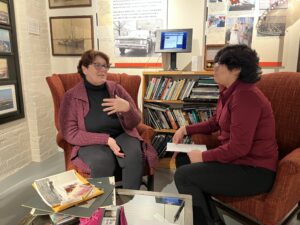 Herstory is an intergenerational oral history project pairing students in high school and college with older women who have ties to New Bedford’s fishing community. Students participate in a series of workshops to learn how to conduct interviews and to better understand the aging process. They then conduct interviews with older women whose stories reflect the varied and important roles of women on New Bedford’s waterfront. These stories are shared in a digital exhibit, co-curated by the students. The Herstory project began in 2022 and is continuing in 2023.
If you know of an older woman who worked on the waterfront or is part of a fishing family who might be interested in sharing their story as part of this project, please contact Project Manager Laura Campbell at herstory@fishingheritagecenter.org.
We are grateful to the Association for the Relief of Aged Women and the Women’s Fund SouthCoast for their support of this project.
Scanning Day

Scanning Day is currently on hold while we address the Collections backlog. If you have materials you’d like to scan, please email programs@fishingheritagecenter.org. We can scan and return your originals, or if you’d like to submit them for consideration of donation, our Collections Committee meets monthly to review those. Please email programs@fishingheritagecenter.org for more information.
The New Bedford Fishing Heritage Center hosts a Scanning Day on the second Saturday of each month from 10:00am to 12:00pm. Scanning Day is an opportunity for the public to share and preserve a digital image of their fishing industry photographs, documents and other records for future generations. The event is free and open to the public.
The Center invites the public to bring their fishing industry related photographs, both historic and contemporary, as well as documents such as settlement sheets, union books, or news clippings to be scanned. Staff will scan the materials and record any information the owner shares about each piece. The owner will leave with their originals along with a digital copy of the scans on a flash drive. The Center is working to create a digital archive of these materials which will be made available to researchers and the public. These documents will help us to tell the story of the fishing industry.
Past Projects
 Workers on the New Bedford Waterfront
In 2016, the New Bedford Fishing Heritage Center (NBFHC) received an Archie Green Fellowship from the American Folklife Center at the Library of Congress to document workers on the New Bedford, Massachusetts, waterfront for the Occupational Folklife Project (OFP). Folklorist and NBFHC Executive Director Laura Orleans, anthropologists Madeleine Hall-Arber and Corinn Williams, and oral historian Fred Calabretta recorded oral histories with 58 workers involved in diverse fishing-related trades on the New Bedford waterfront. Documented trades range from fish packers to net makers, navigational electronic technicians to marine divers, and maritime upholsterers to ice house workers. The interviews are supplemented by striking workplace portraits taken by New Bedford photographer Phillip Mello, who was also interviewed about his job as general manager at Bergie’s Seafood, and who has been taking photographs of his fellow waterfront workers since 1975. Click here to explore the collection. An exhibit produced from this project is currently on display at the Port of New Bedford.
Salted, Pickled, or Smoked: Preserving and Presenting the Cultural Heritage of New Bedford’s Fishing Community: A Year-long Effort To Digitize The Cultural Heritage of New Bedford’s Fishing Community
Commercial fishing is often a family activity with skills and knowledge passed from one generation to the next. Consequently, much of this history resides in the photo albums, documents, and artifacts of fishing families. This project digitized these materials through a day-long public event in combination with “house calls” to digitally document materials from individuals who are unable to attend the event. The project was book ended by a variety of public programs which served to inspire community participation, evoke memories, and provide an interpretive framework for materials that are brought forward. Digitizing these materials, making them publicly available, and using them to tell the story of the fishing community created a lasting legacy for families who have spent generations working the water in what is one of the nation’s oldest occupations.
The project was a collaboration involving the New Bedford Fishing Heritage Center (NBFHC), University Archives and Special Collections at the University of Massachusetts Boston, the Claire T. Carney Library Archives and Special Collections at the University of Massachusetts, Dartmouth, MIT Sea Grant, the New Bedford Public Library, and New Bedford Whaling National Historical Park. The project was being funded through a National Endowment for the Humanities Common Heritage Grant.
This project resulted in the creation of a best-practices “Digitizing Day Handbook” which you can access by clicking here.
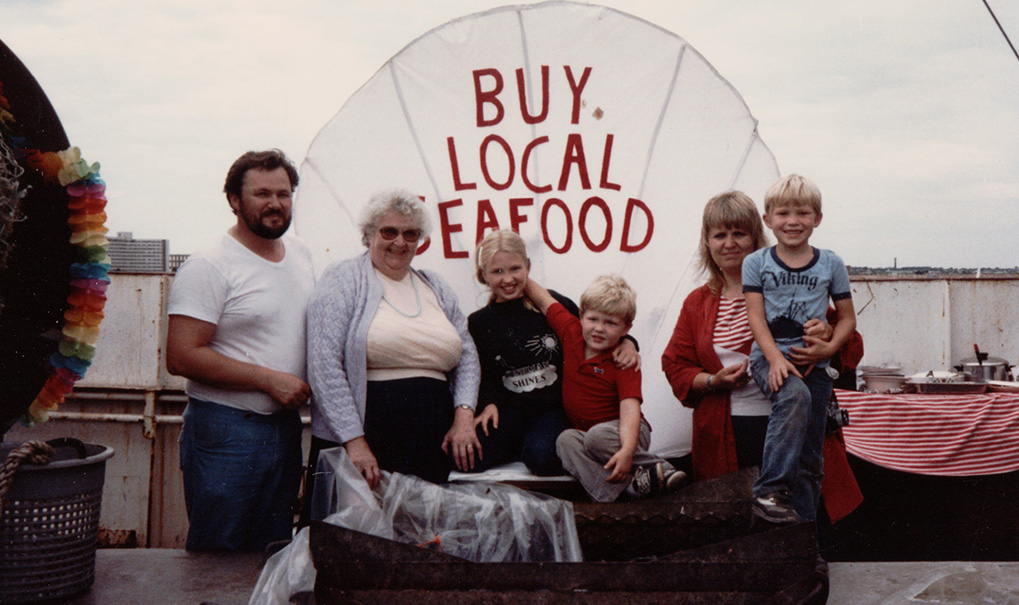

Following the digitization event, UMass Boston processed images and metadata and provided storage and public access through the University’s online repository. These materials are included in the Digital Commonwealth and Digital Public Library of America. In addition to UMass Boston’s online repository, the resulting digital collection will be publicly archived as part of digital collections at the New Bedford Public Library, the Claire T. Carney Library Archives and Special Collections at the University of Massachusetts, Dartmouth, and the Massachusetts Public Library Digital Initiative, and shared as part of digital exhibits on the NBFHC website. Those who participate by sharing their photographs, documents, or artifacts were given a USB drive containing the scanned images of their materials.